Narrator’s disordered eating and body-image distress
Winter in SokchoThe narrator’s disordered eating and body-image distress are presented as a recurring conflict between how others assess her body and how she experiences it from within. Food is at once part of her work and care for others, a subject of family scrutiny, and the medium through which distress becomes physical. The novel gives that conflict no simple resolution: moments of tenderness and self-awareness sit alongside repeated episodes of shame, excess, and bodily pain.
Work, Appetite, and Weight
At Old Park’s Guest House, the narrator insists that she eats plenty: since starting work there, she says, she has consumed vast amounts of toast and milky coffee each morning. Her mother nevertheless suspects that she has lost weight, blames Old Park for not giving her enough time to eat, and threatens to speak to him. The narrator asks her not to. She also defends the kitchen as her domain, noting that Old Park took time to adjust to her cooking but does not interfere. The contrast establishes an early tension: she can claim authority over preparing food while resisting her mother’s interpretation of what her body needs.
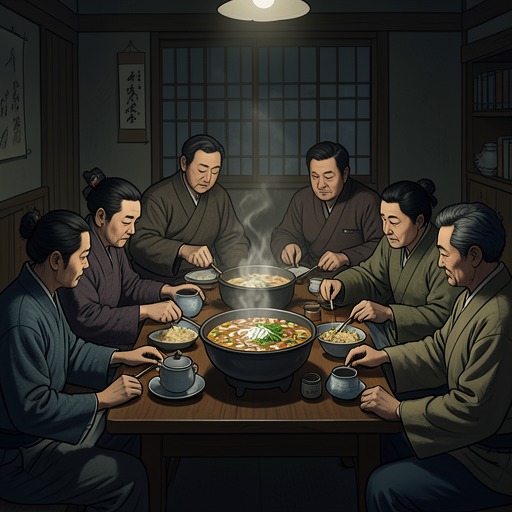
Her work makes food a matter of careful procedure. She sorts tiny octopuses, browns them with shallots, soy sauce, sugar, and diluted bean paste, lowers the heat to keep them from drying out, and adds sesame and slices of sticky rice cake to the thickened sauce. Yet while chopping carrots, she sees their grooved surface reflected in the knife as strangely continuous with the flesh of her fingers. The image briefly unsettles the boundary between ingredient and body. When Yan Kerrand enters for water and watches her, she loses concentration, cuts her palm, and blood runs onto the carrots. He presses a handkerchief to the wound. The scene joins her bodily vulnerability to kitchen labor without making cooking itself a cure: food is her practiced domain, but her body remains exposed to interruption and injury.
Being Seen and Misrecognizing the Body
A photograph taken by Jun-oh makes the narrator confront an image she does not usually see. After he leaves her bed, she turns over the Polaroid he has left behind and watches its colors develop. The portrait frames the curve of her hips in the foreground and her ribs and shoulder blades farther away. She is surprised by how prominent her bones look. Because she never sees herself from behind, she reasons, it makes sense that she does not recognize herself in the picture. The moment captures a gap between an image of her body and her habitual self-perception; it does not settle what she thinks her body ought to look like.
The novel repeatedly places this self-scrutiny beside the act of looking. The narrator watches Yan Kerrand draw and later sees his monochrome panels incorporate recognizable places in Sokcho, while his spare use of lines and blank paper makes the image seem to emerge from light and space. That interest in how an image is made resonates with her attention to the difference between a body as felt and a body as pictured. The connection is suggestive rather than a claim that Kerrand’s drawings explain her distress. Near the end, the sketchbook he leaves behind shows a woman’s body through fragments—a shoulder, belly, breast, and back—before the line narrows to a scar on a thigh. The pages offer another image of bodily detail, but they do not identify the woman as the narrator or resolve her uneasy relation to being seen.
Family Meals and Conflicting Instructions
Eating with her mother turns appetite into a charged social encounter. At a stall near the port, her mother orders a vegetable and seafood pancake and local makgeolli. As the food arrives, the narrator calculates how much she will eat by weighing the size of each mouthful. Her mother talks about the narrator wearing her dress again for her wedding and needing to watch her figure. The narrator begins eating faster, drinks in long swallows, and loses track of the conversation. Her mother is discussing the late fish catch and the difficulty of finding fugu for the coming Seollal meal; the narrator is absorbed in eating and drinking.
The episode becomes physically uncomfortable and socially confusing. Makgeolli spills on her coat, leaving a sour-milk smell, and her mother dabs at it with a napkin before refilling her bowl. The narrator feels sick but continues, while her mother orders another pancake and praises how lovely she looks when eating. By the time she returns to the guest house, her stomach is distended and she staggers. The praise does not relieve the distress: in this meal, attention to her appearance and encouragement to eat coexist, and the narrator experiences the combination as a loss of control.
A later visit to the jjimjilbang repeats the weight commentary in a different setting. While the narrator and her mother scrub one another’s backs, her mother says she has lost weight again and needs to eat more. The narrator’s hands begin to shake; she hates the familiar injunctions to eat more, not become too fat, and manage her body according to others’ shifting expectations. In the bath area she compares her breasts with those of other women and feels reassured by the comparison. That brief reassurance is another form of looking: it offers a momentary measure of her body, not lasting security.
Shame, Excess, and Care
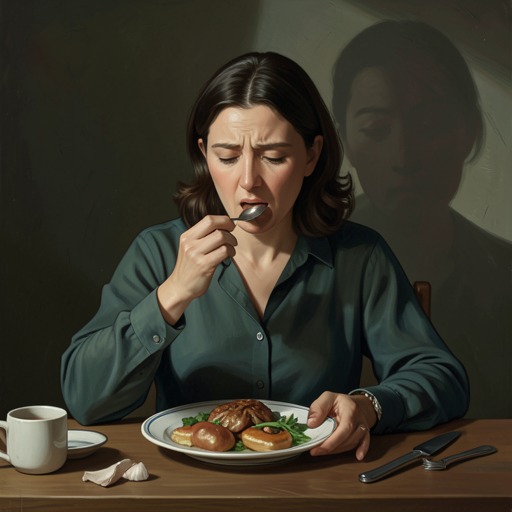
At a family meal, the narrator’s aunt comments on her body and proposes managing her wedding clothes and makeup. She criticizes the narrator’s glasses and suggests eye surgery, offering to pay if her mother cannot. Her mother objects that the narrator is lovely as she is and does not need altering. Yet when the aunt asks why the narrator is stuffing herself, the narrator can no longer lift her spoon to her mouth. She watches a scrap of kimchi fall among the dishes, then stands and leaves rather than going to the cemetery with the family. With no buses running, she walks back holding her abdomen; her stomach hurts from the food she has crammed into it. In the mirror, wind-tangled hair, a skirt spattered with sand and mud, and a bloated stomach become details she wishes Yan Kerrand had not seen.
The most severe episode follows a painful exchange with Kerrand. After telling him that his hero will not find the woman he is seeking in Sokcho, she goes to the kitchen, unwraps sausage from her mother, and eats frantically. The narration describes the sequence as filling a body that stifles her, followed by growing disgust, difficulty speaking, and collapse as her stomach heaves and she vomits bile onto her thighs. Old Park finds her on the kitchen floor. He puts his arms around her, wraps her in his coat, and leads her to her room without speaking. His practical, wordless response contrasts with the family’s repeated comments about her weight and eating: in this moment, care takes the form of staying with her and getting her out of the kitchen, not evaluating her body.
The pattern is not simply a refusal of food or a straightforward effort to control weight. The narrator cooks attentively for others, negotiates meals under scrutiny, sometimes eats until she is in pain, and remains acutely conscious of how her body appears. Near the end, she offers to let Kerrand taste her cooking, a small gesture that places her skill in a relation of invitation rather than performance alone. The invitation does not establish that her distress has ended. Across the novel, eating and being looked at remain entangled, and care appears in particular gestures without erasing the cycle of bodily discomfort and shame.